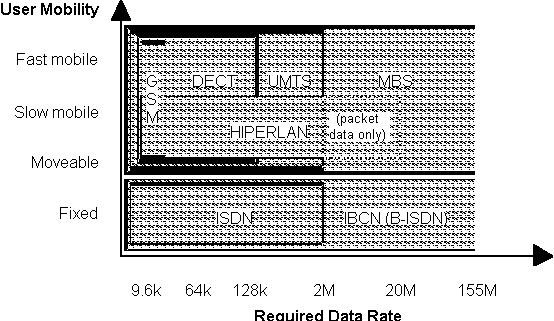
Data rate is really what broadband is about. For example HIPERLAN
allows physical channel bit rates up to 23.5 Mb/s, and in MBS
it can go as high as 155 Mb/s. Such high data rates impose large
bandwidths, thus pushing carrier frequencies for values higher
than the UHF band: HIPERLAN has frequencies allocated in the 5
GHz and 17 GHz bands; MBS will occupy the 40 GHz and 60 GHz bands;
even the infra-red band is being considered for broadband WLANs.
However, many people argue if there is a need for such high capacity
systems, having in mind all the compression algorithms that are
being developed and the type of applications that do require tenths
of Mb/s. One can face this issue from another perspective.
Not too many years ago (really not too many), people would be happy to buy
a Personal Computer with a 33 MHz clock, 4 MB of RAM and 100 MB of hard disk
(of course, lower numbers can be presented here, depending how further back
one goes in time); word-processors, spread-sheets and other computer applications
were used quite successfully, with the drawback of taking some time to run and
being limited by the reduced available memory, however creating files of some
kB. The wish of every user was the increase of frequency clock, RAM and
hard disk memories to run those same applications. But as hardware has been
improved in the last years, also software has increased enormously its needs:
one can buy now a Personal Computer with a clock higher than 1 GHz, a RAM higher
than 128 MB, and a hard disk with a capacity higher than 15 GB (all these values
are orders of magnetude higher than the previous ones), but after installing
the operative system, the word-processor, the spread-sheet, and all the other
applications, several hundreds of MB are already occupied; moreover, it is very
easy to have a file occupying 10 MB, after including all the figures, graphs
and so on.
This need for high capacity systems has been recognized by the Visionary Group,
put together by the European Commission, to give a perspective of what should
be the "hot topics" in the area of Telecommunications for research
in the next European programmes (following RACE and ACTS). In this visionary
perspective of the road to follow, in order to go along the needs of society
in the years to come as far as communications is concerned, capacity is referred
as one of the major issues to be developed, due to the foreseen increase in
demand for new services (specially those based on multimedia); together with
this, personal mobility will impose new challenges to the development of new
personal and mobile communication systems.
A conclusion can be drawn from this: even if at a certain point
in time it may look "academic" to develop a system for
a capacity much higher than what it seems reasonable (in the sense
that there are no applications requiring such high capacity),
it is worthwhile to do it, since almost for sure in the future
(which may be not very far) applications will come out that need
those capacities and even more. The story of fibre optics is elucidative
on that.
The applications and services of the two systems are also different.
HIPERLAN is mainly intended for communications between computers
(thus being an extension of wired LANs); nevertheless it can
support real-time voice and image signals, and users are allowed
to some mobility and can have access to public networks. MBS services
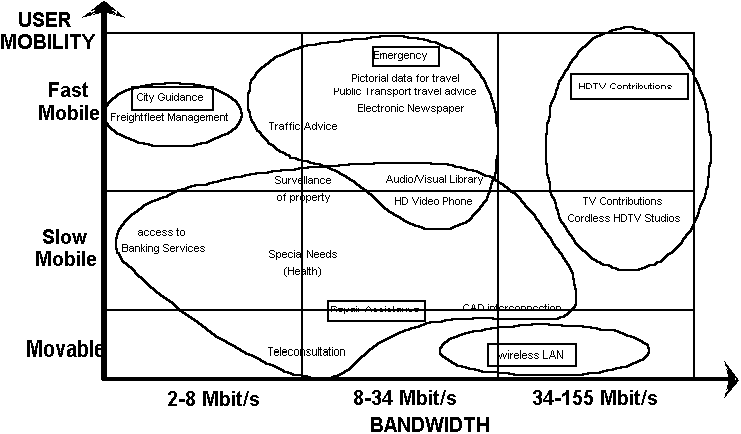
are quite more wide in range: Fig. 2 shows several of the
possible applications, according to their data rate and mobility;
of course these applications are not exclusive of MBS, and many,
if not all, can be seen as possible applications of WBMSs in general.
Some of these applications are already available for fixed and/or
narrowband systems, thus WBMS represents only some extended upgrade
in mobility or data rate; others are really specific of WBMS,
and can only be made available through this type of system. Moreover,
some of the applications require the existence of an operator,
while others can be implemented on a private basis; the future,
in the sense of market impositions, will dictate which ones will
have success as key start services.
| Owner/
Operator | private system, owned and operated by the user | public and private system |
| Objective | extension or replacement of fixed LANs | mobile and wireless extension or replacement of fixed B-ISDN |
| Applications | primarily indoor and on-premises computer interconnection | indoor and outdoor, all IBC services and applications |
| Services/Data Rates | MAC layer (bearer) service rates: < 20 Mb/s for asynchronous services 64 n kb/s, up to 2.048 Mb/s, for time bounded services | ATM cell transfer capability: up to 155 Mb/s |
| Communication | connectionless | connectionless and connection-oriented |
| Infrastructure | no, only HIPERLAN nodes with functions for transmitting and receiving, and optionally for forwarding, bridging and interworking | yes, cellular system consisting of mobile stations, base stations comprising transceivers, controller and interworking units |
| Configurations | stand alone, ad-hoc networking, integration or MAC level bridging with other LANs, interworking with other networks | stand alone, integration with B-ISDN, interworking with other networks |
| Mobility | up to 36 km/h or 2_ rad/s | more than 100 km/h |
| Coverage | locally "unlimited" due to forwarding of active nodes | "unlimited" due to cellular infrastructure and handover |
| Range | up to 50 m at 20 Mb/s and up to 800 m at 1 Mb/s | up to 1 km, depending on antenna and frequency |
| Channel Access | FDMA/TDMA, variable data packets (up to 24322 bit), no frame structure, contention mode with priority | FDMA/TDMA, frame structure with fixed time slots and transmission bursts (356 symbols) |
| Frequency Bands | 5.15 - 5.30 GHz;
17.1 - 17.3 GHz | 39.5 - 40.5 and 42.5 - 43.5 GHz;
62.0 - 63.0 and 65.0 - 66.0 GHz |
| Duplexing | 1 frequency TDD | 2 frequencies FDD, up to 4 carriers in parallel |
| Physical Channel Access | 23.5 Mb/s | 40 to 160 Mb/s |
| Modulation | GMSK | 4- and 16-OQAM |
| Time Scales | 1996 | 2005 |
| Features | ||
| Spectrum allocation | 2 GHz | 40 GHz and/or 60 GHz |
| Bandwidth | up to 2 Mb/s | up to 155 Mb/s |
| Environment | indoor and outdoor (terrestrial and satellite) | indoor and outdoor (terrestrial) |
| Coverage | universal (except maybe remote zones) | targeted areas (small and large continuous ones) |
| Service provision | public and private | public and private |
| Locability | global | service area |
| Mobility classes | vehicle-mounted, portable and hand-held | portable, movable and mobile |
| Personal mobility | user mobility using an identity module on any terminal; support of UPT | user mobility using smart cards or similar on any terminal; support of UPT |
| Interworking | PLMN, PSTN, ISDN and B-ISDN compatible | B-ISDN compatible (all functions for interworking with other systems will be provided by B-ISDN) |
| Applications | ||
| Emergency services | can be provided with severe restrictions on bandwidth | offers additional services related to high quality images |
| City guidance | can be provided | can be provided (offers high quality full motion video) |
| High definition TV | not possible | can be provided |
| High definition video phone | not possible | can be provided |
| LAN interconnection | not possible | can be provided |
| Mobile office | can be provided with severe restrictions on bandwidth | offers additional services related to high quality images |
| Interactive TV | not possible | can be provided |
| Radio extension to B-ISDN | not possible | can be provided |
| Telerobotics | limited image quality | high definition image quality |
European R&D initiatives in mobile systems, and the corresponding
efforts to standardize the upcoming systems has lead to the definition
of UMTS, which is considered as a third generation system. However,
there are differences between the foreseen features and applications
of UMTS and MBS, Table 2, the latter being capable of providing
more advanced services, but with some possible restrictions on
coverage.